
Forklift Lithium Batteries
Quick answer: CMX Battery forklift batteries are 24V / 36V / 48V / 80V LiFePO4 traction packs with an integrated BMS, built as drop-in replacements for lead-acid. They opportunity-charge during breaks — no swap room, no watering — and deliver 2,000–5,000 cycles against roughly 1,000–1,500 for lead-acid. We match voltage, tray, connector and BMS protocol to your truck before delivery.
Why fleets switch to lithium forklift batteries
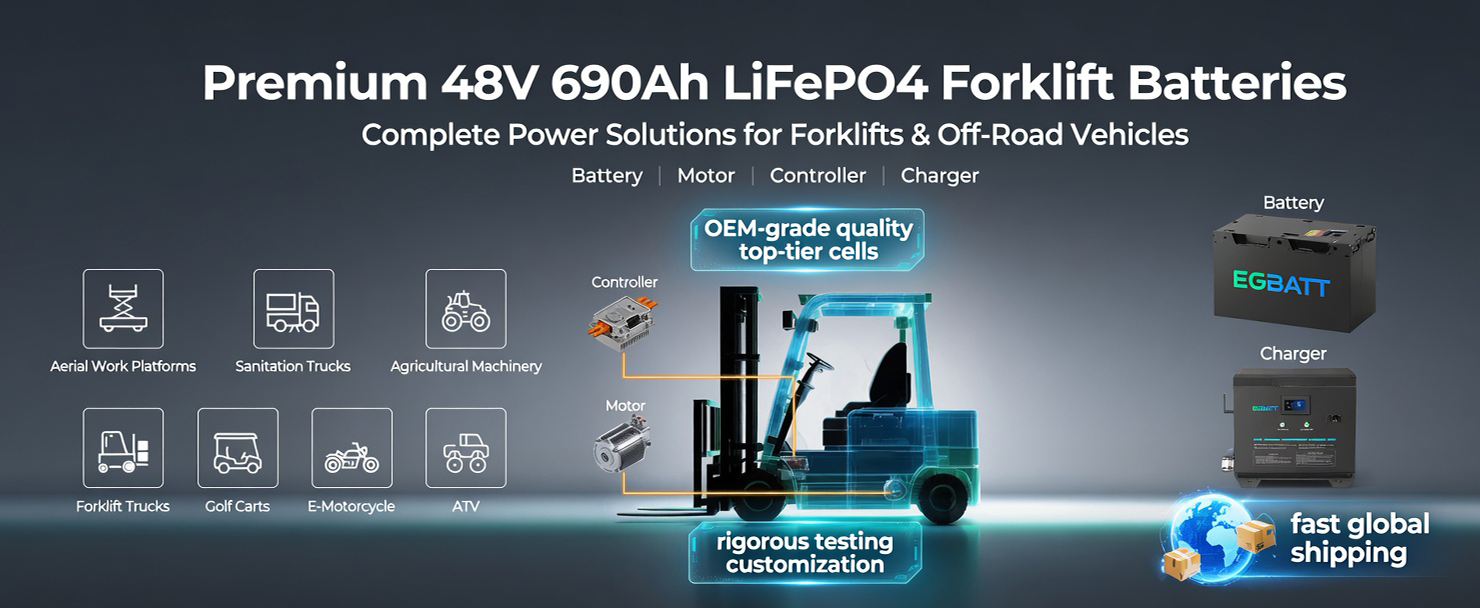
Forklifts run in multi-shift operations where downtime is money. A lead-acid traction battery needs a swap room, a spare battery per truck, an eight-hour charge window plus cool-down, and weekly watering. A lithium pack removes all of it: it opportunity-charges in 30–60 minute breaks, holds voltage through the whole shift so the truck does not sag as it drains, and needs no maintenance.
The economics work on three lines: you buy fewer batteries (one per truck instead of two or three), you recover the floor space used by the swap room, and you remove the labour of watering and swapping. In multi-shift duty the payback is typically well inside the pack’s cycle life.
Voltage selection: which pack fits which truck
| Truck class | Nominal voltage | Typical use | Typical capacity |
|---|---|---|---|
| Pallet truck, stacker | 24V | Warehouse picking, light duty | 150–400Ah |
| Counterbalance 1–2t | 36V | General warehouse | 400–600Ah |
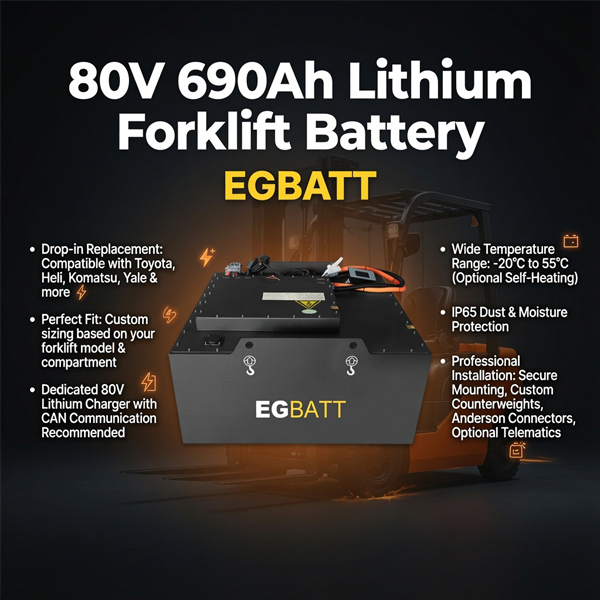
| Counterbalance 2–3.5t | 48V | Warehouse and yard | 400–690Ah |
| Heavy counterbalance, container handler | 80V | Ports, steel, heavy industry | 400–690Ah |
| Reach truck | 48V / 80V | High-bay racking | 300–600Ah |
If you are unsure, send us the truck make, model and the label on the existing battery — voltage is almost always printed on it, and we can confirm the tray and connector from a photo.
Opportunity charging: the operational change that pays for the pack
Opportunity charging means adding charge whenever the truck is idle — breaks, shift handovers, loading waits — instead of running the battery to near-empty and swapping it. Lithium accepts partial charge with no memory effect and no damage, so a 30-minute top-up during a break genuinely extends the working day.
- No battery swap room. One battery per truck, no spares, no change-out crane.
- No cool-down. Lead-acid needs hours after charging; lithium does not.
- Consistent performance. Voltage stays flat through the shift, so travel and lift speeds do not fall off in the last hour.
- Lower energy bill. Around 95% round-trip efficiency versus 80–85% for lead-acid.
Key specifications
| Specification | Value | Why it matters |
|---|---|---|
| Voltage | 24 / 36 / 48 / 80V | Must match the truck’s motor and controller. |
| Charging | Opportunity-charge in breaks | No swap room, no spare battery. |
| Cycle life | 2,000–5,000 cycles | Multi-shift fleets reach this in 5–8 years. |
| Maintenance | None — sealed LFP | No watering, no equalisation, no acid. |
| BMS | Integrated, traction-rated | Cell balancing plus over-current, over-voltage and thermal protection. |
| Enclosure | IP54 standard / IP65 option | Wash-down and outdoor yards need IP65. |
| Cold store | Self-heating option | Enables charging below 0°C. |
| Certifications | UN38.3, IEC 62619, CE, RoHS | Import-ready for EU and most APAC markets. |
LiFePO4 vs lead-acid traction batteries
| LiFePO4 | Lead-acid traction | |
|---|---|---|
| Cycle life | 2,000–5,000 | 1,000–1,500 |
| Batteries per truck | 1 | 2–3 (with swap) |
| Charge time | 1–2h, opportunity capable | 8h + cool-down |
| Maintenance | None | Weekly watering, equalisation |
| Energy efficiency | ≈95% | 80–85% |
| Voltage sag | Flat through the shift | Sags as it discharges |
| Swap room required | No | Yes |
| Upfront cost | Higher | Lower |
| Total cost of ownership | Lower in multi-shift | Higher over 10 years |
How to specify a forklift battery
- Match pack voltage exactly to the truck. 24V for pallet trucks and small stackers, 36V for counterbalance up to ~2t, 48V for 2–3.5t counterbalance, 80V for heavy counterbalance and container handlers. Voltage must match the truck’s motor and controller, not just the old battery label.
- Confirm the charger and connector. Lithium needs a CC/CV lithium profile, and the plug must match your truck — common types include SB, Anderson and DIN. Adapting an existing lead-acid charger is usually a false economy.
- Check BMS communication with the truck or charger. Some trucks and chargers expect a CAN or RS485 handshake. Without it the truck may derate or the charger may not start. Tell us the make and model and we match the protocol.
- Size Ah from shift energy use, not nameplate. Read the truck’s kWh consumption over a shift (most onboard telematics report it) and add 20–30% margin. With opportunity charging you do not need to cover the whole shift from one charge — which is where the capital saving comes from.
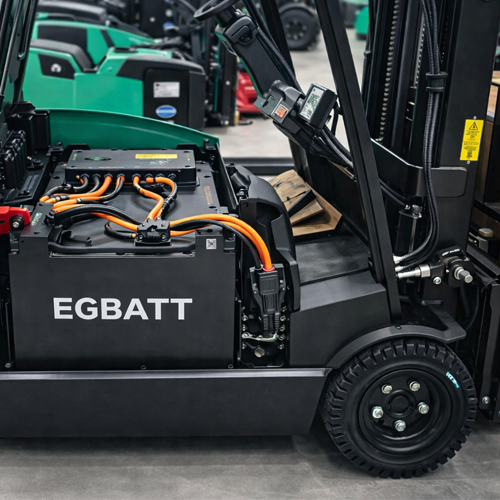
- Confirm tray dimensions, weight and IP rating. Lithium is lighter, so a tray designed for lead-acid may need a ballast plate for counterweight. Outdoor or wash-down applications need IP65.
Typical applications
| Environment | Why lithium fits | Notes |
|---|---|---|
| Multi-shift warehouses | Opportunity charging removes swap downtime | Largest TCO advantage |
| Cold storage | Discharge is fine at low temperature | Charging needs self-heating or a warm area |
| Container handling | High cycle count, high current | 80V packs, IP65 enclosure |
| Fully electric sites | No acid, no gassing, no ventilation | Supports site electrification goals |
| Food and pharma | Sealed, wash-down capable | IP65 and stainless options |
Engineering and testing at CMX Battery
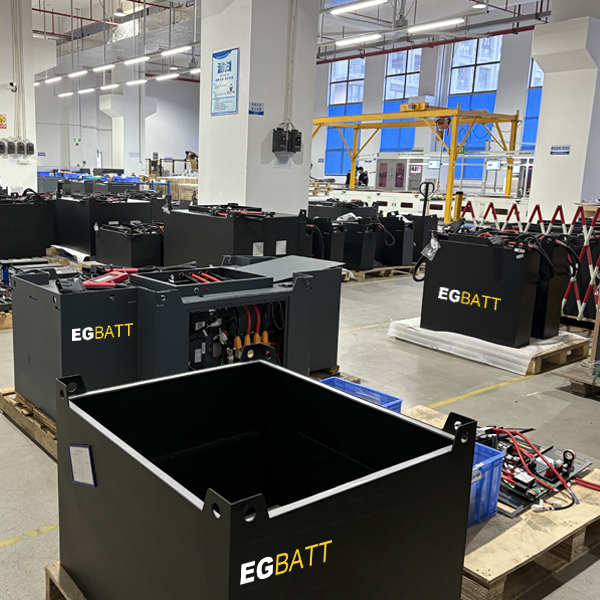
Traction packs are built for shock, dust and temperature swing. We select cells and BMS for high discharge and fast recharge profiles, seal the enclosure to the specified IP rating, and validate the pack through drop, vibration and thermal cycling before it ships. Every pack is logged against its cell batch, so a warranty claim can be traced back to the cells it was built from.
Certifications and compliance
- UN38.3 — mandatory lithium transport test (altitude, thermal, vibration, shock, external short). Required for any cross-border shipment.
- IEC 62619 — international safety standard for industrial lithium cells and batteries; expected by EU and most APAC buyers.
- CE — EU declaration of conformity for the applicable directives.
- RoHS — restriction of hazardous substances in the cells and BMS.
- IP65 — dust-tight and water-jet resistant for outdoor and wash-down enclosures.
Forklift battery FAQ
Can I opportunity-charge a lithium forklift battery?
Yes — that is the main operational advantage. Charge during breaks and shift changes without a battery swap room, without a spare battery and without the 8-hour cool-down lead-acid requires. Lithium accepts a partial charge with no memory effect.
Will it drop into my existing forklift?
In most cases yes. We match pack voltage (24 / 36 / 48 / 80V) and build the pack to your tray dimensions and connector. The three things to confirm are dimensions, connector type and whether the truck’s charger expects BMS communication.
How long does it last compared with lead-acid?
CMX Battery traction packs are rated 2,000–5,000 cycles versus roughly 1,000–1,500 for a lead-acid traction battery. In multi-shift service that typically means one lithium pack outlasts two or three lead-acid sets.
Is any maintenance required?
No. Sealed LiFePO4 means no watering, no equalisation charges and no acid handling. The BMS handles cell balancing and protection automatically.
Do I need to change my charger?
Usually yes. Lead-acid charge curves will not correctly charge lithium and can trigger BMS cut-off. You need a charger with a lithium (CC/CV) profile and the correct connector. We spec the charger with the pack.
Does it work in cold storage?
Yes, with the right configuration. Low-temperature charging is the constraint — charging below 0°C requires a self-heating pack or a heated charge area. Discharging in a cold room is fine. See our self-heating batteries.
What happens to the warranty if I use a third-party charger?
A charger without the correct lithium profile can cause BMS cut-offs and, in the worst case, cell damage. We honour the warranty when the pack is charged within the published limits — which is easy to evidence because the BMS logs current, voltage and temperature.
How do I dispose of the old lead-acid set?
Lead-acid is a mature recycling stream and most scrap dealers will collect it. Do not mix it with lithium waste streams; lithium requires a separate licensed recycler.
Forklift products
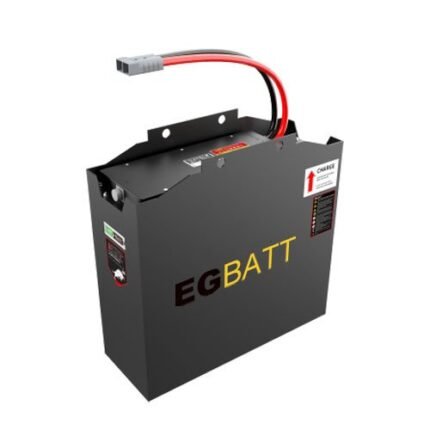
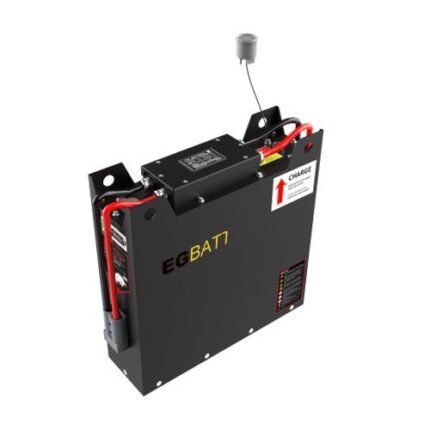
24V 150Ah LiFePO4 Forklift Battery | Fast-Charging Pallet Jack Battery
Upgrade your electric pallet jacks and walkie stackers with a reliable 24V 150Ah LiFePO4 forklift battery designed for fast charging and long service life.
The EG-F24150L delivers 3.84kWh of stable lithium power with significantly lower weight than traditional lead-acid batteries. Built with Grade-A LiFePO4 cells and an intelligent CAN Bus BMS, it provides safe operation, opportunity charging, and maintenance-free performance for demanding warehouse environments.
This CMX Battery 24V 150Ah lithium forklift battery helps reduce downtime, improve efficiency, and lower long-term operating costs for warehouse fleets.
80V forklift lithium battery buying guide — model selection, runtime estimates, and charger compatibility.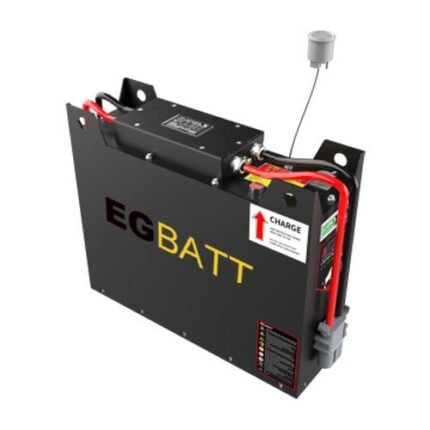
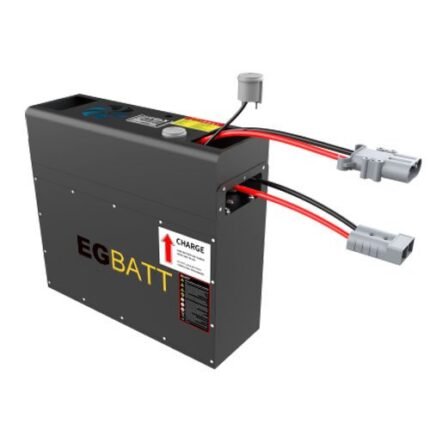
24V 205Ah Lithium Forklift Battery | Drop-In Electric Pallet Jack Replacement
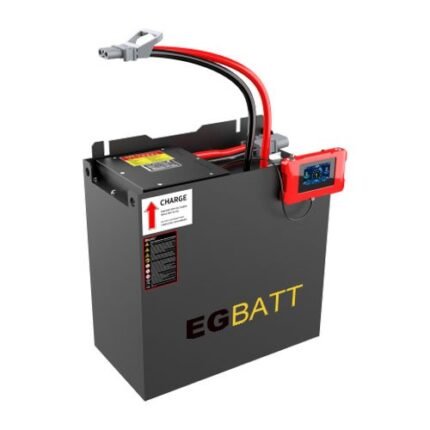
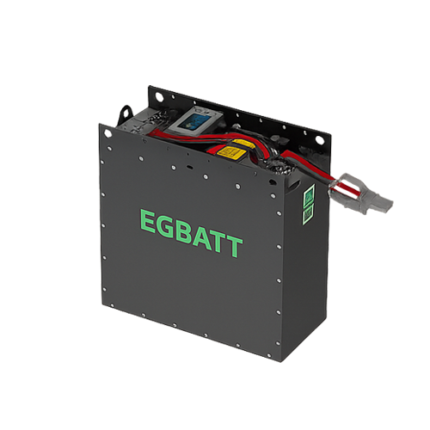
24V 280Ah LiFePO4 Crown Electric Forklift Battery | Fast Charging 7168Wh for AGV
CMX Battery 24V 280Ah LiFePO4 Forklift Battery – F24280F-A is a drop-in lithium solution for Crown forklifts, AGVs, and pallet jacks. End watering, reduce downtime, and increase productivity.
- 7.17kWh High Energy Output – 280Ah capacity provides extended runtime and consistent voltage under heavy loads
- Fast & Opportunity Charging – Recharge up to 80% in about 1.5 hours and charge during breaks without damaging battery life
- Maintenance-Free LiFePO4 Design – No watering, equalization, acid spills, or battery change rooms required
- 3,500+ Deep Cycles – Lasts up to 3–4× longer than traditional lead-acid forklift batteries
- Lower Operating Costs – Reduce energy consumption, maintenance labor, and replacement frequency by up to 70% over battery lifetime
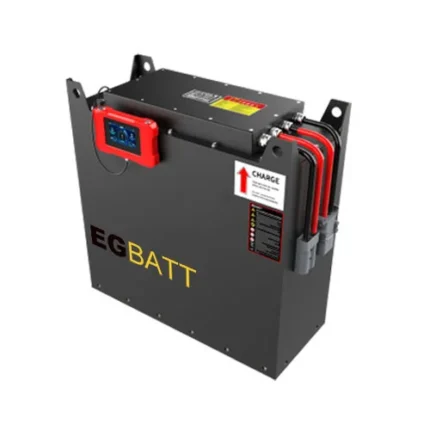
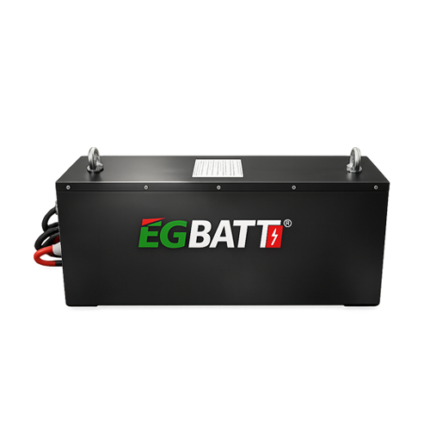
24V 608Ah LiFePO4 Forklift Battery High Capacity Jungheinrich Pallet Jack Battery
The CMX Battery high-capacity 24v 608Ah Lithium forklift battery designed for Jungheinrich pallet jacks, delivering reliable, long-lasting performance in demanding material handling environments.
Built with Grade-A lithium iron phosphate cells, this forklift battery offers a superior alternative to traditional lead-acid options. It’s maintenance-free, supports fast charging, and provides a much longer service life, reducing equipment downtime and keeping your operations running smoothly.
By upgrading to this advanced LiFePO4 forklift battery, you can cut replacement frequency, improve energy efficiency, and save 20–40% on total cost of ownership over time. Whether you’re running a warehouse, distribution center, or manufacturing facility, this lithium forklift battery is a smart investment in performance, durability, and cost savings.
80V forklift lithium battery buying guide — model selection, runtime estimates, and charger compatibility.More in this series
Explore related solutions
- Residential Energy Storage
- Whole Home Battery Backup
- Off-Grid Solar Systems
- C&I Energy Storage
- Peak Shaving Systems
- UPS Battery Solutions
- Telecom & UPS Backup
- RV Lithium Batteries
- Marine LiFePO4 Batteries
- Golf Cart Lithium Batteries
- Robot Battery Packs
- Military Battery Packs
- All Solutions
Request a forklift battery quote
Send us your truck make and model, voltage, shift pattern and charger details — we return a matched pack proposal within three working days.