
Golf Cart Lithium Batteries
Quick answer: CMX Battery golf cart batteries are 48V / 51.2V LiFePO4 packs with an integrated BMS, built as drop-in replacements for 36V and 48V lead-acid sets. They deliver 2,000–5,000 cycles instead of 500–1,000, cut roughly 60% of the weight, and charge in 2–4 hours. You will need a lithium-profile charger, and the pack’s discharge rating must exceed your controller’s peak current.
Why golf carts are an ideal lithium application
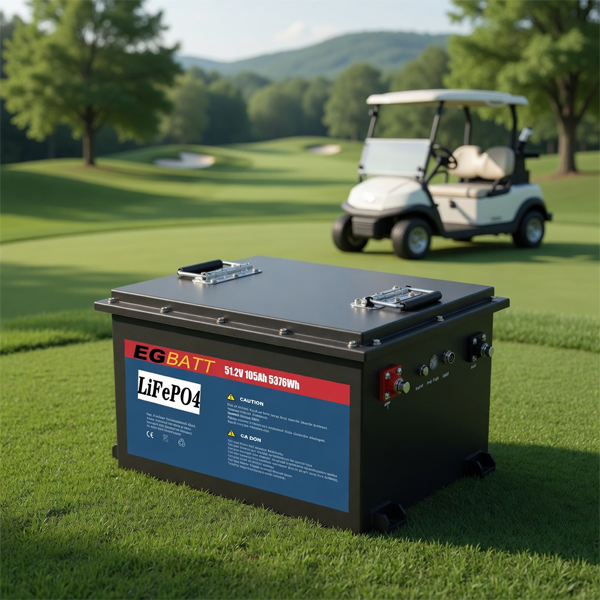
A golf cart is a near-perfect duty cycle for LiFePO4: predictable daily depth of discharge, a known charging window overnight, high vibration, and a weight penalty that directly costs range and turf wear. Lead-acid in a cart is heavy, needs watering, loses voltage as it discharges so the cart gets slower through the round, and lasts three to five years.
A single lithium pack replaces the whole series string, removes about 60% of the battery weight, and holds voltage flat from full to nearly empty — so the cart drives the same on the 18th hole as it did on the first.
Lead-acid vs lithium in a golf cart
| LiFePO4 pack | Lead-acid set (6x8V) | |
|---|---|---|
| Cycle life | 2,000–5,000 | 500–1,000 |
| Service life | 8–12 years | 3–5 years |
| Weight | ≈45–55kg | ≈130–160kg |
| Usable capacity | 90% | 50% |
| Charge time | 2–4 hours | 8–10 hours |
| Maintenance | None | Monthly watering, terminal cleaning |
| Voltage under load | Flat | Sags through the round |
| Range per charge | 2–3 rounds (100Ah) | 1–2 rounds (equivalent set) |
| Upfront cost | 2–3x | Lowest |
36V, 48V or 72V?
| System | Found on | Lithium replacement | Notes |
|---|---|---|---|
| 36V | Older carts, some utility vehicles | 38.4V LiFePO4 | Verify controller voltage window |
| 48V | The overwhelming majority of modern carts | 48V / 51.2V LiFePO4 | Direct replacement, widest choice |
| 72V | High-speed and lifted custom builds | 72V / 76.8V LiFePO4 | Usually a custom pack |
If your cart has six 8V batteries or eight 6V batteries, it is a 48V system and a 51.2V LiFePO4 pack is the correct replacement. The small voltage difference is intentional — 51.2V is the nominal voltage of a 16-cell LFP string and sits inside the operating window the cart was designed for.
Key specifications

| Specification | Value | Why it matters |
|---|---|---|
| Voltage | 38.4V / 48V / 51.2V / 76.8V | Must match the cart’s motor and controller. |
| Capacity | 60Ah – 200Ah | 100–105Ah covers most 48V carts. |
| Continuous discharge | 100A – 200A | Must exceed controller peak or the BMS cuts out. |
| BMS | Integrated with Bluetooth option | Protection plus readable state of charge from a phone. |
| Cycle life | 2,000–5,000 cycles | 8–12 years of typical course use. |
| Weight | ≈1/3 of a lead-acid set | Less turf wear, better acceleration, more range. |
| Enclosure | IP65 option | Wash-down and wet-climate carts. |
| Certifications | UN38.3, IEC 62619, CE | Import-ready. |
How to spec a golf cart lithium battery
- Confirm the cart’s system voltage. Look at the existing battery set: six 8V batteries is 48V, eight 6V is 48V, four 12V is 48V. Lithium replacements are 48V / 51.2V for 48V carts and 36V for older 36V carts. Never mix voltages.
- Check the controller and its peak current. Read the controller label — common values are 275A, 350A and 400A peak. The pack’s continuous and peak discharge rating must exceed the controller’s peak, or the BMS will cut out under acceleration.
- Decide capacity from rounds-per-charge. One 18-hole round on flat ground is roughly 1.5–2.5kWh at the pack. A 48V 100Ah pack is 5.12kWh nameplate and about 4.6kWh usable — two rounds comfortably, three with care.
- Specify the charger and the gauge. Order a LiFePO4-profile charger with the correct plug for your cart, and either a lithium-compatible state-of-charge meter or a shunt. A lead-acid fuel gauge will read near-full until the pack cuts out.
- Measure the tray and plan the mounting. Lithium is much lighter, so the tray usually needs a hold-down bracket or a spacer to stop the pack moving. Check height clearance under the seat as well as footprint.
The four things that trip up a conversion
- The charger. A lead-acid charger will not correctly charge lithium and may be rejected by the BMS. Budget for a lithium-profile charger with the right plug.
- Controller regen. Some older controllers push bus voltage up during regenerative braking, which can trigger BMS over-voltage protection. Check the controller or disable regen.
- The fuel gauge. A lead-acid gauge reads voltage, and lithium voltage is flat — so it shows full until the pack cuts out. Fit a shunt-based meter or use the BMS app.
- Mounting. The pack is a third of the weight, so the original hold-down may no longer locate it. Add a bracket or spacer so it cannot move under the seat.
Range: what to expect
| Pack | Nameplate energy | Usable energy | Typical rounds (flat course) | Hilly course |
|---|---|---|---|---|
| 48V 60Ah | 3.07kWh | ≈2.8kWh | 1–2 | 1 |
| 48V 100Ah | 5.12kWh | ≈4.6kWh | 2–3 | 1.5–2 |
| 48V 150Ah | 7.68kWh | ≈6.9kWh | 3–4 | 2–3 |
| 48V 200Ah | 10.24kWh | ≈9.2kWh | 4–5 | 3–4 |
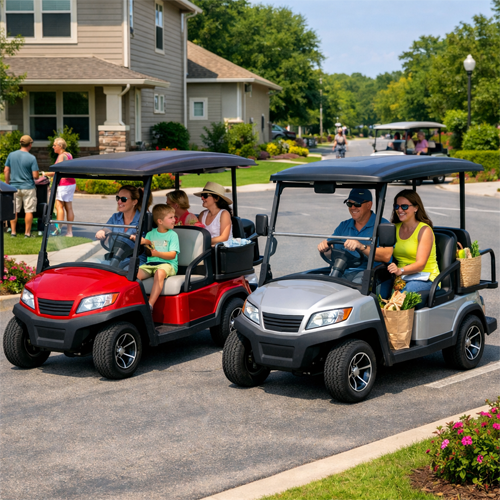
Figures assume 1.5–2.5kWh per 18 holes at the pack. Lifted carts, larger tyres, passengers and hilly terrain all push consumption up — if you are converting a lifted or street-legal cart, go one size larger than the table suggests.
Fleet and resort duty
For courses, resorts and gated communities the argument shifts from range to management. Lithium packs opportunity-charge between rounds, need no watering schedule, and report state of charge over Bluetooth or CAN — so you manage the fleet on actual charge rather than on a calendar. Over a fleet of 50 carts the labour saving alone is usually larger than the energy saving.
Certifications and compliance
- UN38.3 — mandatory lithium transport test; required for any cross-border shipment.
- IEC 62619 — international safety standard for industrial lithium cells and batteries.
- CE — EU declaration of conformity. RoHS — hazardous substances.
- IP65 — dust-tight and water-jet resistant for wash-down carts.
Golf cart battery FAQ
How long will a lithium golf cart battery last?
CMX Battery golf cart packs are rated 2,000–5,000 cycles. For a typical course cart that is 8–12 years of service, against 3–5 years for a well-maintained lead-acid set.
Can I just swap lead-acid for lithium in my cart?
Usually yes, but check four things first: the charger (you need a lithium profile), the controller’s regen behaviour (some older controllers push voltage too high on regen), the tray dimensions and the battery gauge (lead-acid fuel gauges read lithium incorrectly).
How much range will I get?
Estimate it from usable energy: a 48V 100Ah pack holds 5.12kWh, of which about 90% is usable. A golf cart uses roughly 1.5–2.5kWh per 18 holes on flat ground, more on a hilly course. That is two to three rounds per charge for a 100Ah pack.
Do I need a new charger?
Yes, in almost every case. Lead-acid chargers apply an equalisation or float behaviour that a lithium BMS will reject, and their voltage profile undercharges LFP. Use a charger with a LiFePO4 profile.
Is 48V or 51.2V correct?
Both are used, and they describe the same physical pack differently: 51.2V is the nominal voltage of a 16-cell LiFePO4 string, which sits inside the operating window of a ’48V’ lead-acid system and is the correct lithium replacement for one.
Why does my cart shut down on a hill?
Almost always a BMS current limit rather than an empty battery. Lithium holds voltage under load, so the controller draws more current than it did from lead-acid. Size the pack’s continuous discharge rating to the controller’s peak, especially on hilly courses or with lifted carts and larger tyres.
Can I use it in a fleet or resort cart?
Yes — fleet duty is where lithium pays back fastest. Opportunity charging between rounds, no watering, and telemetry from the BMS let you manage the fleet by state of charge instead of by calendar.
Do I need to keep the cart plugged in?
No, and you should not leave it at 100% for long storage. Lithium is happiest stored at 40–60% state of charge in a cool place. Unlike lead-acid it does not need a float maintainer.
Golf cart products
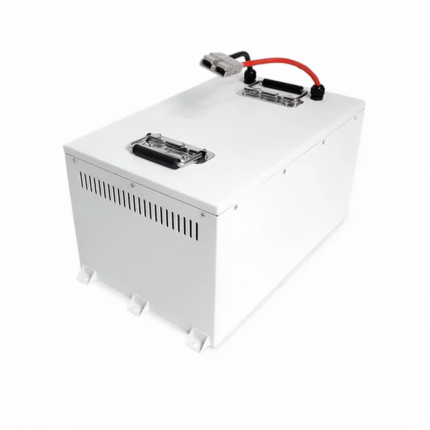


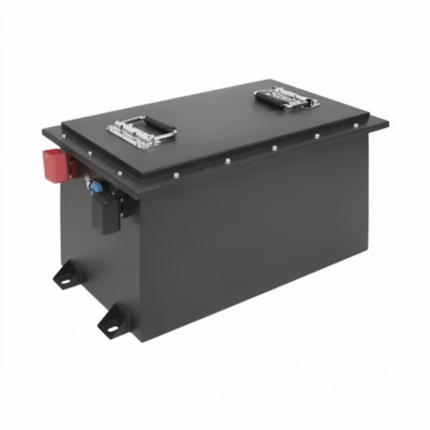
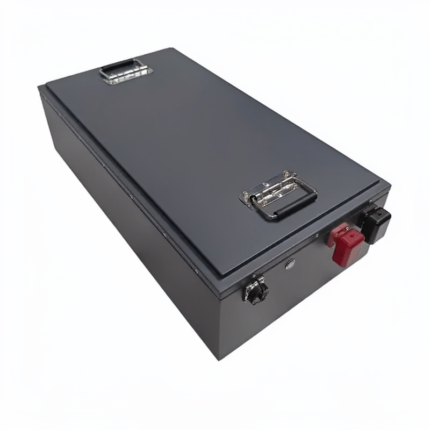
48V 105Ah LiFePO4 Golf Cart Battery | 51.2V Lithium Replacement Battery with Bluetooth BMS
More in this series
Explore related solutions
- Residential Energy Storage
- Whole Home Battery Backup
- Off-Grid Solar Systems
- C&I Energy Storage
- Peak Shaving Systems
- UPS Battery Solutions
- Telecom & UPS Backup
- Forklift Lithium Batteries
- RV Lithium Batteries
- Marine LiFePO4 Batteries
- Robot Battery Packs
- Military Battery Packs
- All Solutions
Request a golf cart battery quote
Tell us your cart make, system voltage, controller peak current and rounds-per-charge target — we confirm the pack, charger and gauge in one proposal.