

Military rechargeable batteries
Quick answer: A military-grade battery is not a marketing label — it is a pack engineered to a named environmental and electrical specification, with test evidence for each claim. CMX Battery builds custom military and rugged lithium assemblies to customer specifications: wide operating temperature, shock and vibration resistance, sealed and EMI-managed enclosures, and full cell-to-serial-number traceability. Tell us which standard you must meet and we build to it.
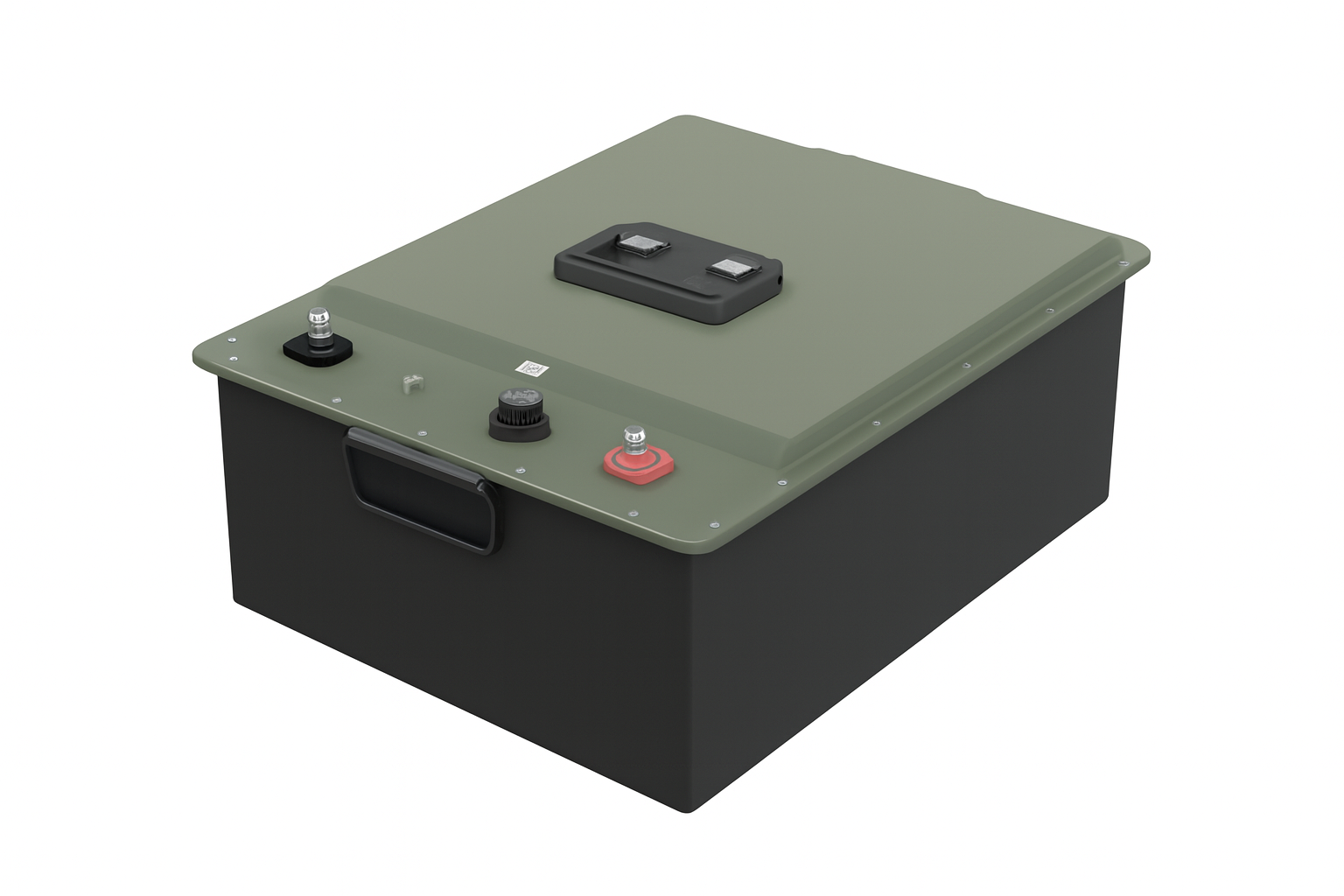
What ‘military grade’ actually means
There is no certificate called military grade. The phrase is shorthand for a pack that has been engineered against a defined specification and can show test evidence for each requirement. In practice that specification is a customer document — often referencing MIL-STD-810 for environmental engineering and MIL-STD-461 for electromagnetic compatibility — plus a safety and transport baseline such as UN38.3 and IEC 62133 or UL.
The practical consequence for a buyer: the useful question is not ‘is it military grade?’ but ‘which MIL-STD methods has it been tested to, and can I see the report?’. A supplier who cannot answer that is selling a label.
Typical environmental requirements
| Requirement | Typical target | Why it matters | How it is achieved |
|---|---|---|---|
| Operating temperature | -40°C to +60°C (discharge) | Desert heat and arctic cold both kill packs | Cell chemistry, heated enclosure or electrolyte formulation |
| Storage temperature | -40°C to +70°C | Shelf life between deployments | Low self-discharge cells, controlled storage SoC |
| Shock | MIL-STD-810 method 516 | Weapon firing, vehicle transit, airdrop | Potted or braced cell stack, isolated mounting |
| Vibration | MIL-STD-810 method 514 | Vehicle and rotorcraft mounting | Braced stack, strain-relieved interconnects |
| Ingress | IP67 or better | Fording, rain, salt fog | Sealed enclosure with rated gaskets and connectors |
| Altitude | Up to 15,000ft and beyond | Low-pressure dielectric and cooling behaviour | Vent/seal design and derating |
| EMC | MIL-STD-461 where specified | Must not interfere with comms | Shielded enclosure, filtered I/O |
| Salt fog | MIL-STD-810 method 509 | Naval and littoral deployment | Marine-grade finishes and sealed hardware |
Chemistry selection
| Chemistry | Energy density | Temperature behaviour | Best for |
|---|---|---|---|
| NMC (Li-ion) | 200–260Wh/kg | Standard -20°C to +60°C | Man-portable, UAV, weight-critical payloads |
| LiFePO4 | 120–160Wh/kg | Good high-temp tolerance | Vehicle, shelter and platform power where safety dominates |
| LTO | 70–90Wh/kg | Excellent at both extremes | Extreme cold, extreme fast charge, long calendar life |
| Primary Li-SOCl2 | High, non-rechargeable | Very wide, 10–20 year shelf life | Unattended sensors, memory backup |
| Primary Li-MnO2 | Moderate, non-rechargeable | Good low-temperature pulse | Comms and emergency beacons |
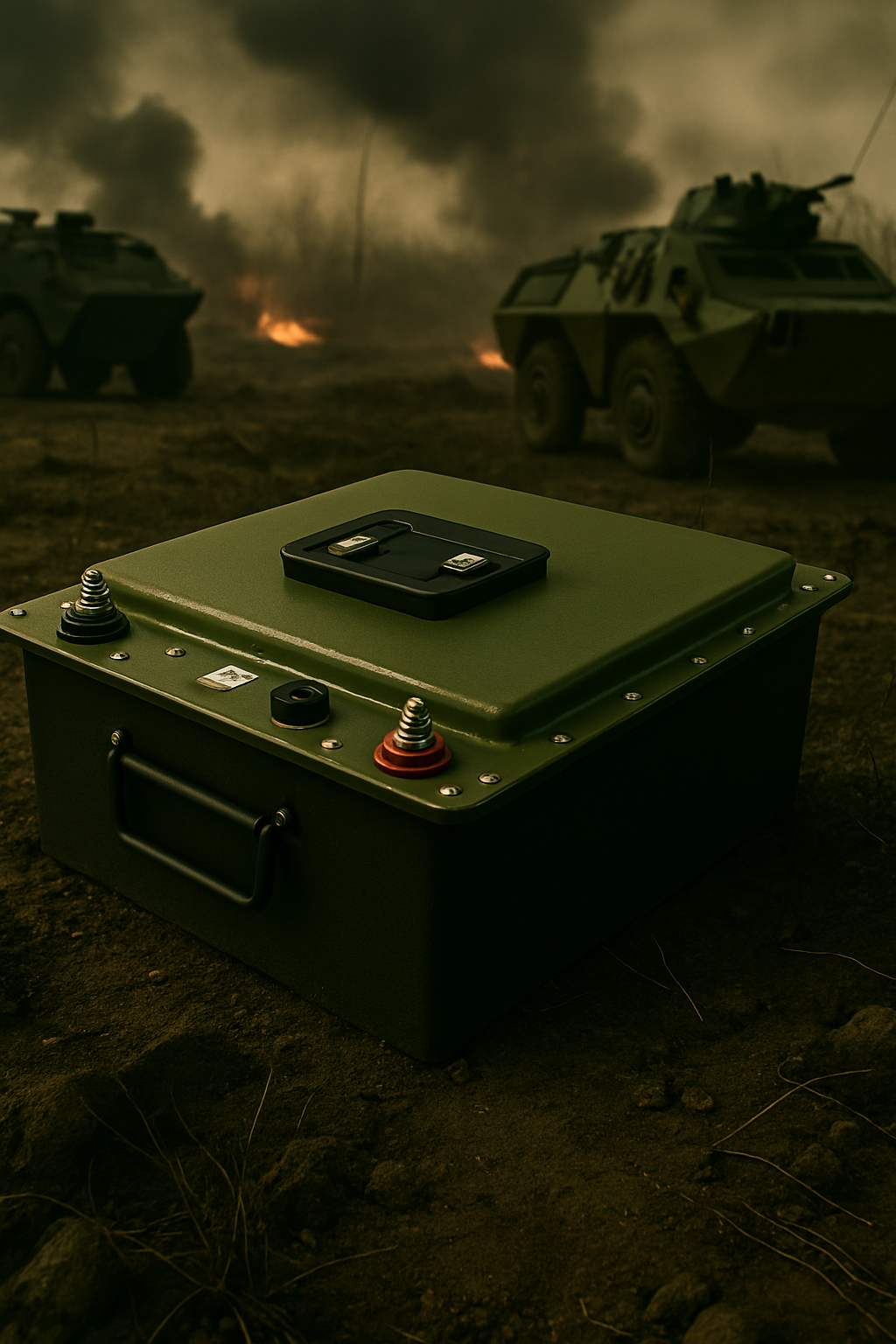
LiFePO4 vs NMC for defense programs
A military rechargeable battery is almost always lithium-ion: NMC where energy density and weight dominate, LiFePO4 where safety margin, cycle life and thermal stability lead the requirement. For defense programs where thermal runaway must be minimised — crewed vehicles, sheltered electronics, munitions-adjacent equipment — LiFePO4 is typically preferred; for tight airframe and handheld weight budgets, NMC is often accepted with additional protection circuitry. The chemistry choice also fixes the BMS limits, the protection scheme and the transport class, so it is settled early in the specification rather than at the end.
How to specify a custom military battery
- Start from the environmental profile, not the capacity. Write down the actual operating and storage temperature range, shock and vibration levels, altitude, humidity and salt-fog exposure, and ingress rating. These drive cell choice, enclosure and potting far more than capacity does.
- Choose chemistry against the profile. NMC for energy density, LiFePO4 where abuse tolerance and cycle life dominate, LTO for extreme temperature and fast charge, primary lithium for long shelf life. There is no chemistry that wins on every axis.
- Define the electrical interface and communication. Voltage window, continuous and peak current, connector type and pin-out, and whether the host needs SMBus, CAN or a simple analogue gauge. Define this with the platform team before the mechanical design freezes.
- Design the enclosure for the environment. Sealing to the required IP rating, EMI shielding if MIL-STD-461 applies, shock isolation for the cell stack, and a thermal path that works at both ends of the temperature range.
- Plan the qualification test programme. Agree the test matrix up front — which MIL-STD methods, which safety standard, what sample size — so qualification evidence exists before production, not after.
Military battery vs commercial battery
The difference is really about risk. When failure costs a mission, a platform or a life, the premium for qualification, traceability and documentation is justified; when the use is low-stakes and easily replaced, commercial packs are usually the better economics.
| Dimension | Military / custom | Commercial off-the-shelf |
|---|---|---|
| Qualification | Built and tested to a referenced environmental standard, e.g. MIL-STD-810 methods | Consumer-grade test only |
| Traceability | Per-batch and per-serial build records retained | Batch lot code only |
| Environment | Wide temperature, shock and vibration, sealed enclosures | Indoor or light-duty use |
| Mechanical fit | Built to the enclosure, connector and mounting you specify | Fixed formats and terminals |
| Lead time | Longer, build-to-spec | Immediate |
| Unit cost | Higher | Lower |
Typical applications
| Application | Priority | Typical approach |
|---|---|---|
| Man-portable radio and comms | Weight, runtime, EMC | NMC pack, shielded enclosure, SMBus gauge |
| Night vision and targeting optics | Compact size, low noise | NMC or primary, tight form factor |
| Unattended ground sensors | Shelf life, temperature | Primary lithium or LTO |
| UAV and small UAS | Energy density, discharge rate | High-C NMC with thermal management |
| Vehicle and shelter power | Safety, cycle life, capacity | LiFePO4 with IP67 enclosure |
| Soldier-worn systems | Weight, conformal shape | Curved NMC or polymer pack |
Military battery applications by platform
Different deployed platforms stress a pack in different ways, so a single off-the-shelf unit rarely fits every program. Specifying per platform protects both performance and program budget.
Military drone battery
A military drone battery is optimised for high discharge current at low weight, with tight cell balancing so voltage stays stable under aggressive throttle changes. Airframe packs also need a predictable weight and centre of gravity, and a fuel gauge the ground station can trust.
Military radio battery
A military radio battery delivers a sustained medium draw with clean output near communications gear, where electrical noise can degrade signal quality. Form factor usually follows the radio family’s battery footprint so field swapping needs no adapters.
Tactical battery pack
A tactical battery pack is man-portable and often hot-swappable, prioritising ergonomics, rugged connectors and quick field exchange over maximum energy. Consistent state-of-charge reporting and predictable behaviour at temperature extremes matter more than headline capacity.
Portable military power supply
A portable military power supply provides multi-voltage output for mixed loads, frequently paired with vehicle or solar inputs for extended missions. The pack behaves as a small energy system: charger integration, output protection and clear state-of-charge reporting are part of the design.
Quality, traceability and documentation
Defence programmes are bought on documentation as much as on hardware. Every CMX Battery assembly is built against a controlled bill of materials with cell batch traceability, and each unit carries a serial number linking it to its build record, end-of-line test data and inspection sign-off. We supply the test reports, material declarations and certificate of conformance your quality system asks for.
- Cell-to-serial-number traceability and retained build records.
- End-of-line electrical test data for every unit, not a sample.
- Environmental test reports against the methods you specified.
- Material declarations and RoHS / REACH documentation.
- Controlled change notification — you hear about a component change before it happens, not after.
Safety, transport and compliance
- UN38.3 — mandatory lithium transport test; required for air, sea and road movement.
- IEC 62133 — baseline safety standard for portable sealed lithium cells and batteries.
- UL 2054 / UL 1642 — North American pack and cell safety equivalents where required.
- MIL-STD-810 / MIL-STD-461 — environmental and electromagnetic performance, built to the methods named in your specification.
- Export control — where a programme carries export-control obligations, these are managed through the customer’s compliance process; we provide the technical file.
Certifications and compliance deep-dive
Transport and electromagnetic compatibility are non-negotiable for fielded power, and both shape the design as much as capacity does.
- UN 38.3 — the mandatory lithium transport test for air, sea and road movement. A UN 38.3 military battery shipment is supported by a valid test summary, with cells and packs tested as they will ship.
- MIL-STD-461 (EMC) — programs that run radios and sensors alongside the pack reference these limits. Emissions and immunity behaviour is engineered in — shielding, filtering, layout — and specific test levels are quoted per program.
- Export control — designs tied to a specific NSN or defense program can fall under export-control rules. Confirm jurisdiction before drawings or specifications are shared.
Authoritative references: MIL-STD-810 environmental test methods, UN 38.3 transport testing and the IP Code (IEC 60529) for ingress protection.
Military battery FAQ
What makes a battery ‘military grade’?
There is no single certification called military grade. In practice it means the pack is engineered and tested to a defined environmental and electrical specification — typically wide operating temperature, shock and vibration resistance, sealed enclosure, electromagnetic behaviour and full traceability — with test evidence for each claim.
Which standards apply to military batteries?
Commonly referenced documents include MIL-STD-810 for environmental engineering (shock, vibration, temperature, altitude, salt fog), MIL-STD-461 for electromagnetic compatibility, and UN38.3 plus IEC 62133 or UL for safety and transport. Which apply depends on the platform and the customer’s specification — we build to the document you name.
What temperature range can you achieve?
Standard lithium-ion charges between 0°C and 45°C and discharges from -20°C to 60°C. Wide-temperature designs extend discharge well below -20°C using heated enclosures or specialised electrolytes, and high-temperature designs push the upper limit past 70°C. Tell us the profile and we will quote to it.
Can you build to an existing NSN or part number?
Yes. We regularly reverse-engineer legacy packs to match form, fit and function — send a sample or a drawing with the electrical specification and we will quote a build-to-print or an improved-design replacement.
Do you handle export-controlled designs?
We supply commercial and dual-use battery assemblies and build to customer specifications. Where a programme carries export-control obligations, those are handled by the customer’s compliance process; we provide the technical documentation needed for it.
What cell chemistries do you use?
NMC for energy density, LiFePO4 for safety and cycle life, LTO for extreme temperature and fast charge, and primary lithium (Li-SOCl2 and Li-MnO2) for long-shelf-life applications such as memory backup and unattended sensors.
How is traceability handled?
Every pack is built against a documented bill of materials with cell batch traceability, and each unit carries a serial number linking it to its build record, test data and inspection sign-off.
What is the typical lead time?
Engineering samples typically ship in four to six weeks after design freeze, depending on cell availability and the extent of environmental testing required. Production follows sample approval.
Is a military drone battery different from a radio pack?
Yes — discharge rate, weight budget and BMS limits differ by platform. A drone pack prioritises high discharge current and low mass; a radio pack prioritises clean, sustained output and a footprint that matches the radio family.
Are your packs UN 38.3 compliant for shipping?
Yes. Packs ship with a valid UN 38.3 test summary, and cells and packs are tested as they will be transported — by air, sea or road.
Military battery vs commercial battery — which do I need?
Choose a military or custom pack when failure is mission-critical and you need qualification, traceability and documentation. Choose commercial off-the-shelf when budget and lead time dominate a low-risk application.
Can you supply a waterproof military battery?
Yes. Enclosures are sealed to the ingress protection rating your specification calls for, with connectors and venting chosen to match.
Can your packs operate near radios without interference?
Emissions and immunity are engineered for deployment alongside communications and sensor equipment, with shielding and filtering designed in. Specific MIL-STD-461 test levels are quoted per program.
Why specify a custom military battery with CMX
CMX Battery engineers custom batteries for defense applications to buyer specification: chemistry and BMS chosen for the platform, enclosures sealed to the required ingress rating, and documentation that runs from cell lot to finished serial number. As a military battery manufacturer producing at our Dongguan facility, we quote against your environmental profile and certification targets rather than a fixed catalogue.
Related solutions: Commercial & Industrial ESS and LiFePO4 Cells.
Build your rugged assembly with CMX Battery
Rugged and defence assemblies are engineered to a named specification, so the route always starts with a design review rather than a catalogue. Use the entry points below depending on whether you need a new design, a build-to-print replacement, or a branded programme.
Design routes
- Custom battery pack design
- OEM / ODM process
- Private label LiFePO4
- Certifications and compliance
- Request a quote
More in this series
Explore related solutions
- Residential Energy Storage
- Whole Home Battery Backup
- Off-Grid Solar Systems
- C&I Energy Storage
- Peak Shaving Systems
- UPS Battery Solutions
- Telecom & UPS Backup
- Forklift Lithium Batteries
- RV Lithium Batteries
- Marine LiFePO4 Batteries
- Golf Cart Lithium Batteries
- Robot Battery Packs
- All Solutions
Request a rugged battery quote
Send us your environmental specification, electrical requirements, mechanical envelope and the standards you must meet — we respond with a build approach within three working days.
Recommended for this application
Explore CMX LiFePO4 solutions engineered for this industry — OEM & B2B supported.