
Blog
Golf Cart Lead-Acid to Lithium: Real ROI & Payback

Quick answer: A lithium golf cart conversion typically pays back in about 2–4 years for a private cart and faster for a fleet. LiFePO4 costs roughly 2–3× more upfront than a lead-acid set, but it delivers about double the usable capacity, lasts 5–10× longer, needs no watering, and charges in 2–4 hours instead of 8–10. Over eight years, one lithium pack usually replaces three or more lead-acid sets — which is where the payback comes from.
Key facts
- Cycle life: 2,000–5,000 (LiFePO4) vs 300–500 (lead-acid) — the core of the ROI math.
- Usable capacity: ~100% vs ~50%, so a smaller lithium pack matches your old range.
- Weight (48 V 100 Ah): ~45 lb vs ~120 lb — faster acceleration and less wear.
- Charge time: 2–4 h vs 8–10 h — less downtime, more daily rounds.
- Maintenance: none — no watering, no equalising, no acid handling.
- Typical payback: 2–4 years for private carts, faster for high-use fleets.
The upfront cost gap
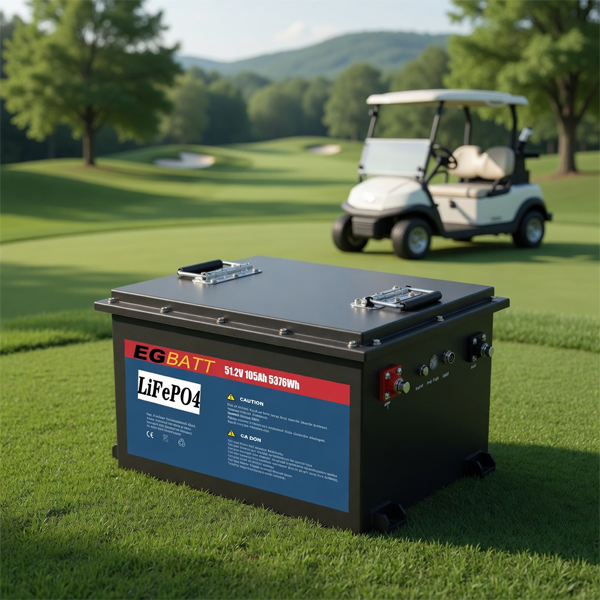
There is no way around it: a lithium golf cart battery costs more on day one than a lead-acid set — usually about two to three times as much. That is the number buyers focus on, and it is the wrong number. The right number is the total cost of ownership over the life of the cart, and there lithium wins clearly.
Five-year total cost of ownership
| Item | Lead-Acid | LiFePO4 |
|---|---|---|
| Upfront purchase | Lower | Higher |
| Lifetime (cycles) | 300–500 | 2,000–5,000 |
| Sets needed over 8 years | 3–4 | 1 |
| Maintenance (watering/equalising) | Required regularly | None |
| Energy cost per charge | Higher (charging losses) | Lower |
| Downtime for charging | 8–10 h | 2–4 h |
| Range on the same Ah | ~50% usable | ~100% usable |
The payback math, step by step
Say a lead-acid set costs X and lasts about two years in regular use, so eight years needs four sets — four times the purchase price plus maintenance labour. A single lithium pack at roughly 2.5× the price of one lead-acid set covers those same eight years. As soon as the lithium pack outlives the second lead-acid set — typically in year two to four — the buyer is ahead, and every year after that is pure savings.
The hidden savings
Three costs never appear on the price tag. First, maintenance labour: watering and equalising lead-acid takes time every month. Second, downtime: an 8–10 hour charge means a cart is out of service for a full shift, where a 2–4 hour lithium charge fits between rounds. Third, energy: lead-acid wastes more energy as heat during charging, so the electricity bill is higher over the pack’s life.
Performance gains that come free
Removing 75 lb of battery weight (48 V 100 Ah: about 120 lb down to about 45 lb) makes the cart accelerate better, climb hills more easily, and put less strain on the motor and tyres. Because LiFePO4 holds voltage flat as it discharges, the cart does not slow down as the charge drops — a difference riders notice immediately.

When does lead-acid still make sense?
If a cart is rarely used, if the upfront budget is the only constraint, or if the cart is near the end of its service life, lead-acid can still be the rational choice. Lithium pays back through usage — the more rounds per week, the faster the return. For low-use private carts, the payback is slower; for courses and rental fleets running daily, it is fast.
Fleet economics
For fleets, the case is stronger again. Every cart that spends 8–10 hours charging is a cart that cannot earn. Cutting charge time to 2–4 hours, removing monthly maintenance, and eliminating acid handling and disposal all pile onto the same ROI. Fleet operators also get predictable battery replacement schedules instead of a rolling lead-acid replacement treadmill.
CMX Battery builds lithium golf cart batteries and LiFePO4 cells in-house, which is why our packs balance cost, cycle life, and warranty support for both private and fleet buyers.
Related Buyer Guides
- Golf cart lithium battery buying guide
- RV lithium battery guide
- Marine battery basics: deep-cycle vs cranking
How long does it take for a lithium golf cart battery to pay for itself?
Typically 2–4 years for a private cart, and faster for a fleet that runs daily. The payback comes from outlasting multiple lead-acid sets, plus savings on maintenance, downtime, and energy.
Is a lithium golf cart battery really cheaper than lead-acid?
Not upfront — lithium costs roughly 2–3× more to buy. But over 8 years one lithium pack usually replaces three or more lead-acid sets and needs no maintenance, so lifetime cost is lower.
How much weight does a lithium conversion save?
A 48 V 100 Ah lead-acid bank weighs about 120 lb, while a LiFePO4 pack of the same rating is about 45 lb — roughly 75 lb saved, which improves acceleration and hill climbing.
Do I need to change my golf cart charger for lithium?
Yes. LiFePO4 needs a lithium charging profile. If your old charger is lead-acid only, use the pack’s supplied charger or a matched replacement.
How long does a lithium golf cart battery last per charge?
A typical two- to four-seat cart on flat terrain runs about 25–40 miles per charge (roughly two to four rounds). Hilly or lifted carts draw more, so size up if you add lights, audio, or USB.
Is lithium safe for a golf cart in hot climates?
Yes. LiFePO4 is far more thermally stable than other lithium chemistries, and quality packs include a BMS with high-temperature cutoff and often an IP-rated case for outdoor mounting.
Get a Quote
Ready to spec the right battery? Tell us your voltage, capacity, and application and our engineers will size a LiFePO4 pack for you.
Frequently Asked Questions
1. Is it worth converting a golf cart from lead-acid to lithium?
Often yes: lithium is lighter, charges faster, needs no maintenance, and lasts far longer per cycle, lowering total cost of ownership despite higher upfront price. ROI is strongest for daily or commercial use.
2. How much does a lithium golf cart battery conversion cost?
Cost depends on voltage (36V/48V) and capacity. A single drop-in 48V LiFePO4 pack typically replaces six 8V lead-acid batteries. Request a quote from CMX Battery with your cart model and range needs.
3. How long do lithium golf cart batteries last vs lead-acid?
LiFePO4 golf cart packs commonly deliver 2000-5000 cycles versus 300-1000 for lead-acid, often 3-5x the service life under similar use.
