
Blog
Golf Cart Lithium Battery Buying Guide (2026)

Quick answer: Choose a LiFePO4 pack that matches your cart’s voltage (36 V or 48 V), then size amp-hours for range — 60–100 Ah for light use, 105–160 Ah for four riders or hills, and 160 Ah+ for lifted carts with accessories. Confirm the tray footprint and terminal layout, make sure your charger supports a LiFePO4 profile, and check that the BMS includes over-current, temperature, and short-circuit protection. Buy once, at the right size, and the pack lasts 2,000–5,000 cycles.
Key facts
- Match the cart’s voltage: 36 V (three 12 V) or 48 V (four 12 V). Never mix voltages in one bank.
- Capacity drives range, not speed. Size up rather than under-spec.
- LiFePO4 gives ~100% usable capacity vs ~50% for lead-acid, and about one-third the weight.
- Cycle life: 2,000–5,000 — one pack often outlasts three lead-acid sets.
- The charger must support a LiFePO4 profile; a lead-acid charger will under-charge and can damage cells.
- The BMS is the real spec: over-current, over/under-voltage, short-circuit, and temperature cutoff plus cell balancing.
Why switch from lead-acid to lithium?
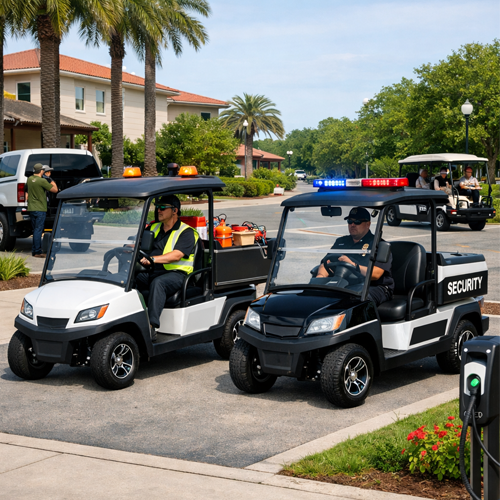
Lead-acid carts work, but they fight you: watering, equalising, acid spills, and a short 300–500 cycle life. A lithium golf cart batteries gives 2,000–5,000 cycles, close to 100% usable capacity, and roughly one-third the weight — so the cart accelerates better, climbs hills more easily, and carries more.
Voltage and pack math (36 V vs 48 V)
Match your cart’s existing voltage. A 36 V cart typically uses three 12 V batteries (or six 6 V); a 48 V cart uses four 12 V (or eight 6 V). A single 48 V LiFePO4 pack replaces the whole bank and simplifies wiring. Never mix voltages or chemistries in one bank.
Capacity (Ah): how much do you need?
| Use case | Riders / terrain | Recommended capacity |
|---|---|---|
| Light private use | 1–2 riders, flat | 60–100 Ah |
| Standard course use | 2–4 riders, some hills | 105–160 Ah |
| Heavy / lifted cart | Accessories, hills, 4 riders | 160–200 Ah+ |
| Fleet / rental | Daily multi-shift use | 160 Ah+, high-cycle cells |
When in doubt, size up. LiFePO4 handles the extra capacity without the weight penalty of lead-acid, and running a pack at a lower depth of discharge extends its cycle life.
BMS and safety specs that matter
The Battery Management System is the real brains. Look for over-current, over- and under-voltage, short-circuit, and temperature cutoff protection, plus active cell balancing. For exposed mounting, an IP-rated case keeps rain and dust out. A weak BMS is the most common reason a cheap lithium pack fails early.
Drop-in compatibility and chargers
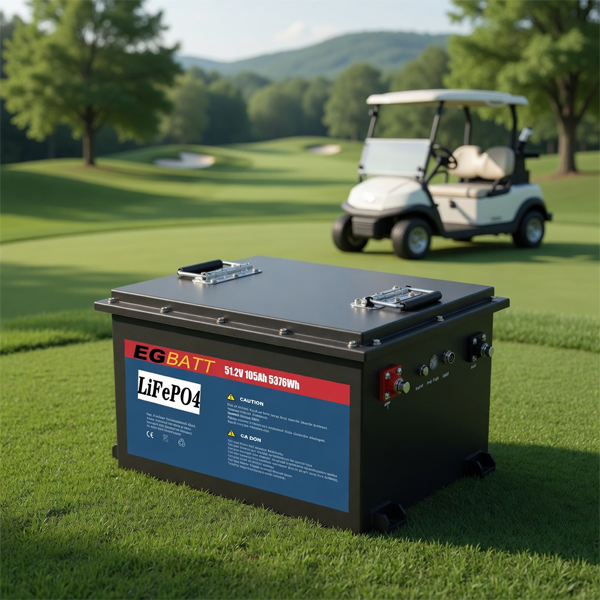
Most 36 V/48 V carts accept a drop-in pack if the tray and terminals match. The catch is the charger: it must support a LiFePO4 profile. If your old charger is lead-acid only, use the pack’s supplied charger or a matched replacement — charging lead-acid profiles on lithium can damage cells.
OEM and custom packs
Standard sizes fit most Club Car, EZ-GO, and Yamaha carts. When the tray is unusual or you need specific terminations, a custom battery pack from an OEM supplier solves fit and performance in one step. 48V golf cart battery range covers the common factory sizes.
Cost vs value
Yes, lithium costs more upfront — often 2–3× lead-acid. But over 5–10 years the total cost of ownership is lower: one pack instead of two or three lead-acid replacements, no maintenance labour, and far less downtime. For fleets, the math is even stronger.
Golf cart battery comparison
| Spec | Lead-Acid | LiFePO4 (CMX Battery) |
|---|---|---|
| Cycle life | 300–500 | 2,000–5,000 |
| Usable capacity | ~50% | ~100% |
| Weight (48 V 100 Ah) | ~120 lb | ~45 lb |
| Maintenance | Watering/equalising | None |
| Charge time | 8–10 h | 2–4 h |
| Memory effect | Yes | No |
CMX Battery builds LiFePO4 cells in-house, which is why our golf cart packs balance cost, cycle life, and warranty support for B2B and fleet buyers.
Related Buyer Guides
- Golf cart lead-acid to lithium: real ROI & payback
- RV lithium battery guide
- Marine battery basics: deep-cycle vs cranking
Can I just drop a lithium battery into my existing golf cart?
In most 36 V/48 V carts, yes — if the pack matches your tray and voltage and your charger has a LiFePO4 profile. Some models need a voltage converter or a charger swap, which we spec during quoting.
What size lithium battery do I need for my golf cart?
Match your cart’s voltage (36 V or 48 V) and size Ah for range: 60–100 Ah for light use, 105–160 Ah for four riders or hills, and 160 Ah+ for lifted carts with accessories.
How long does a 48V 100Ah lithium golf cart battery last per charge?
A typical two- to four-seat cart on flat terrain runs about 25–40 miles per charge (roughly two to four rounds). Hilly or lifted carts draw more, so size up to 160 Ah+ if you add lights, USB, or audio.
Will a lithium pack work with my old charger?
Only if the charger supports a lithium/LiFePO4 charging profile. If not, use the pack’s supplied charger or a matched replacement — charging lead-acid profiles on lithium can damage cells.
Is LiFePO4 safe in hot climates?
Yes. LiFePO4 is far more thermally stable than other lithium chemistries. Quality packs include a BMS with high-temperature cutoff and often an IP-rated case for outdoor mounting.
How long will a lithium golf cart battery last?
Quality LiFePO4 packs are rated for 2,000–5,000 cycles — typically 8–10 years of regular use — versus 1–2 years for lead-acid, which is why the lifetime cost is lower.
Get a Quote
Ready to spec the right battery? Tell us your voltage, capacity, and application and our engineers will size a LiFePO4 pack for you.
Frequently Asked Questions
1. What should I look for when buying a lithium golf cart battery?
Check voltage (36V/48V), capacity (Ah), continuous discharge rating, BMS quality, physical fit, and warranty. A drop-in 48V LiFePO4 pack simplifies conversion.
2. What voltage lithium battery does my golf cart need?
Match the cart’s system: 36V carts need 36V packs, 48V carts need 48V. Mixing is not advised. CMX Battery supplies matched 36V/48V LiFePO4 golf cart packs.
3. How long does a lithium golf cart battery last?
Expect 2000-5000 cycles and several years of typical use, with minimal capacity loss, versus 1-2 years common for lead-acid in daily service.
