

How a BMS Works: Protection, Cell Balancing & Communication
Quick answer: A battery management system (BMS) is the electronics that keep a lithium pack inside its safe operating area. It monitors cell voltages, pack current and temperature; it protects against over-charge, over-discharge, over-current and short circuit; it balances cells so they age together; and it reports state of charge to the host device. Without a BMS, a LiFePO4 pack will be destroyed by a single over-discharge event.
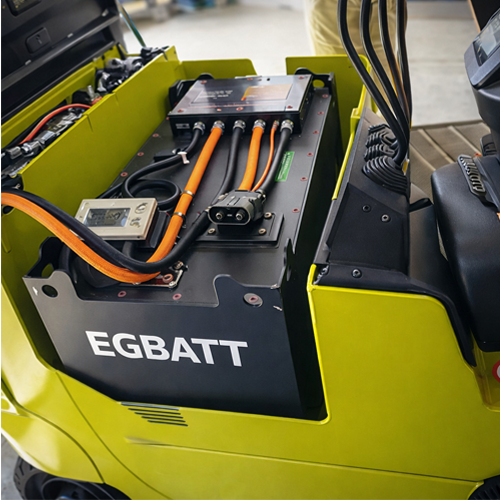
- Core protections: over-voltage, under-voltage, over-current, short circuit, over- and under-temperature
- LFP cell limits: charge to 3.65 V, do not discharge below about 2.5 V per cell
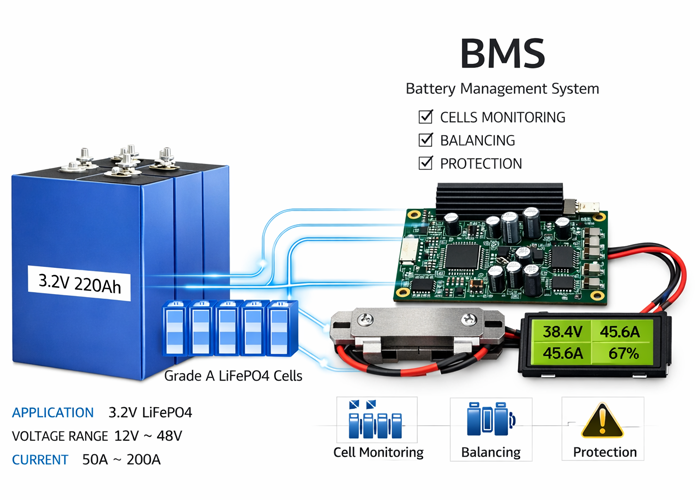
- Balancing: passive balancing bleeds excess charge as heat; active balancing moves energy between cells
- Communication: CAN or RS485, protocol-matched to the inverter or host device
What does a BMS actually do?
Four jobs: measure, protect, balance and communicate. Measurement without protection is monitoring, not management; protection without balancing lets the weakest cell drag the whole pack down.
1. Measurement
The BMS reads every cell group’s voltage, the pack current via a shunt or hall sensor, and temperature at one or more points. From these it derives state of charge and state of health.
2. Protection
When any parameter leaves its safe window the BMS opens a contactor or switches off MOSFETs. For LiFePO4 the critical thresholds are per-cell over-voltage around 3.65 V, under-voltage around 2.5 V, plus over-current and temperature limits set by the cell datasheet.
3. Balancing
Cells drift apart in capacity and self-discharge. Balancing equalises them so the pack delivers its full capacity instead of being limited by the first cell to hit a cut-off. Passive balancing dissipates the excess as heat; active balancing transfers charge between cells and is used on larger packs.
4. Communication
The BMS reports state of charge, alarms and limits to the inverter, charger or vehicle over CAN or RS485. Protocol matching is the single most common integration failure — confirm it in writing before you buy.

Protection thresholds at a glance
| Parameter | Typical LFP threshold | What it prevents |
|---|---|---|
| Cell over-voltage | 3.65 V (cut-off ~3.75 V) | Lithium plating, overheating, fire risk |
| Cell under-voltage | 2.5 V (cut-off ~2.0 V) | Copper dissolution and permanent capacity loss |
| Charge over-current | Set by cell datasheet, often 0.5–1 C | Overheating and plating during fast charge |
| Discharge over-current | 1–3 C continuous, higher surge | Busbar and cell overheating |
| Short circuit | Instantaneous disconnect | Fire and cell rupture |
| High temperature | Typically 55–60 °C cut-off | Accelerated degradation and thermal runaway |
| Low-temperature charge | 0 °C cut-off without heating | Lithium plating on the anode |
Why a single over-discharge can ruin a pack
Below roughly 2.5 V per cell the copper current collector begins to dissolve and can re-deposit as metallic dendrites inside the cell, creating an internal short. The damage is permanent and invisible from outside. This is why a BMS with a low-voltage cut-off and a low quiescent draw is not optional — it is the difference between a pack that lasts ten years and one that fails in a single season of storage.
How to tell whether a BMS is properly specified
- Continuous and surge current ratings exceed your inverter’s maximum demand
- It is matched to the chemistry — LFP and NMC have different termination voltages and curves
- It monitors temperature, not just voltage, and blocks charging below 0 °C
- The communication protocol is confirmed compatible with your inverter model and firmware
- Balancing current is adequate for the pack size (typically 50–200 mA for passive systems)
- It has the certifications your market requires as part of the pack, not on its own
Frequently asked questions
Do I need a BMS for a LiFePO4 battery?
Yes, always. Lithium cells have no tolerance for over-charge or over-discharge, and a single deep discharge below about 2.5 V per cell can permanently damage the cell. The BMS is what enforces the safe operating window.
What is the difference between passive and active balancing?
Passive balancing bleeds excess charge from the highest cells as heat through a resistor — simple, cheap, and adequate for most packs. Active balancing moves energy between cells using capacitors or inductors, which is more efficient and faster, and is worth it on large packs or where cells are badly matched.
Why does my BMS disconnect the battery under load?
Because a protection threshold was crossed — most often discharge over-current when a motor or compressor starts, or a single cell group hitting under-voltage under load. Check the inverter surge rating against the BMS continuous and peak current limits; the fix is usually a higher-rated BMS, not a bigger battery.
Can I use any BMS with any inverter?
No. Communication is the usual failure point: the BMS and inverter must agree on a protocol over CAN or RS485. Ask the supplier to confirm compatibility with your specific inverter model and firmware in writing before purchase.
What state of charge should I store a LiFePO4 pack at?
Around 50% for long-term storage, in a cool dry place. A BMS with low quiescent current will keep the pack healthy for months; without one, parasitic loads can slowly pull it into damaging under-voltage.
Does a BMS prevent thermal runaway?
It greatly reduces the risk by preventing the electrical abuse — over-charge, over-current, extreme temperature — that leads to it, but it cannot prevent runaway from internal cell defects or physical damage. That is why cell grade, mechanical design and thermal management matter alongside the BMS.
Specify the right BMS for your pack
Send your pack voltage, capacity, peak current and inverter model. We will confirm the protection thresholds, balancing approach and communication protocol that suit your application — in writing, before tooling.
Related reading: how to size a battery bank and cycle life and degradation.