

Blog
208V vs 480V Commercial Hybrid Inverter: Selection Guide

Choosing a commercial hybrid inverter is not simply a matter of matching a kilowatt rating. For a three-phase solar and battery project, the building service voltage, load profile, battery voltage, PV string design, backup strategy and utility requirements all have to work together.
This guide explains how to select a 208V or 480V commercial hybrid inverter for warehouses, workshops, farms, retail buildings, offices and other commercial and industrial facilities. It also shows where a 30–70kW inverter platform fits—and which questions should be answered before equipment is ordered.
Quick answer: Choose a 208V commercial hybrid inverter when the facility has 120/208V three-phase service, and choose a 480V model for 277/480V service. In this CMX Battery platform, the 30kW 208V hybrid inverter serves 120/208V projects, while the 40kW, 50kW, 60kW and 70kW models are designed for 277/480V systems. The final choice must also match the measured load, battery power and required backup time.
What Does a Commercial Hybrid Inverter Do?
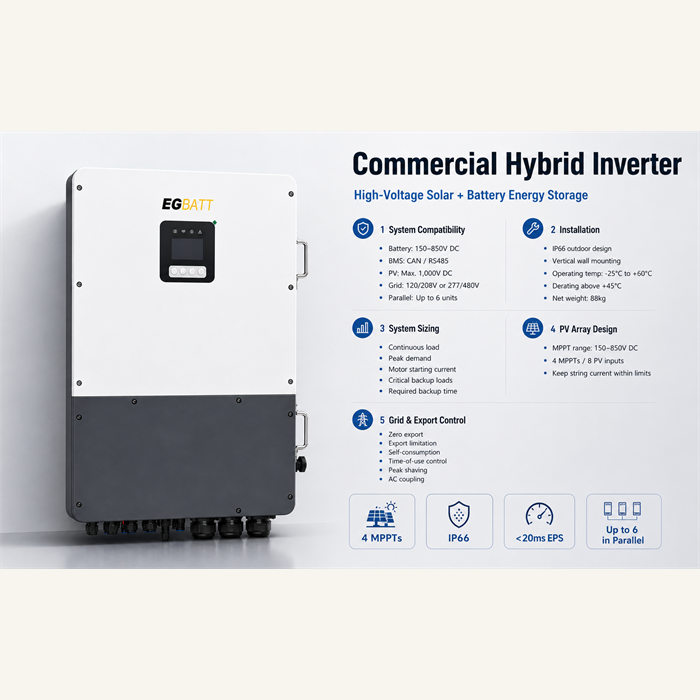
A commercial hybrid inverter coordinates several parts of an energy system through one control platform:
- Solar PV generation
- High-voltage battery charging and discharging
- Three-phase grid connection
- Critical-load or EPS backup
- Energy-management functions such as self-consumption, time-of-use control, peak shaving and export limitation
Unlike a conventional grid-tied solar inverter, a hybrid inverter can manage battery storage and protected loads when the complete system is correctly designed. That makes it useful for businesses that want to reduce peak demand, shift energy use to lower-cost periods, increase solar self-consumption or maintain selected operations during an outage.
The first decision, however, is not the battery capacity or PV size. It is the facility’s electrical service.
208V vs 480V: Start With the Building Service
North American commercial sites commonly use either 120/208V three-phase service or 277/480V three-phase service. The inverter’s AC voltage and grid configuration must match the point of interconnection. Selecting the wrong voltage can introduce unnecessary transformers, added losses, more equipment, additional cost and a more complicated approval process.
| Selection factor | 120/208V three phase | 277/480V three phase |
|---|---|---|
| Typical facilities | Small commercial buildings, workshops, retail sites and light industrial loads | Larger warehouses, factories, agricultural processing and higher-power equipment |
| Example inverter size in this platform | 30kW | 40kW, 50kW, 60kW or 70kW |
| Design priority | Confirm 120/208V wye service, neutral requirements and phase loading | Confirm 277/480V service, connected loads and switchgear ratings |
| Common mistake | Assuming every “208V” site has the same conductor and grounding arrangement | Adding a transformer without evaluating cost, losses and protection coordination |
Do not select an inverter from a utility bill or panel label alone. A qualified designer should verify line-to-line voltage, line-to-neutral voltage, phase sequence, service configuration, grounding, neutral requirements and the proposed interconnection point.
A Common Selection Error: Adding a Transformer Too Early
One recurring mistake during early C&I system planning is to select an inverter before confirming the service voltage, then try to correct the mismatch with a transformer. For example, specifying a 480V inverter for a 208V building may look workable on a preliminary equipment list, but the transformer adds conversion losses, protection coordination, floor or wall space, installation labor and another component that must be maintained. The better sequence is to verify the service first and compare a native 30kW 208V hybrid inverter with a transformer-based alternative only when the project has a clear engineering reason for doing so.
Engineering note: The inverter should match the voltage and configuration at the actual point of interconnection—not merely the voltage printed on a nearby panel. Confirm the single-line diagram, line-to-line and line-to-neutral measurements, neutral and grounding arrangement, switchgear rating and utility requirements before the model is approved.
How to Size a 30–70kW Three-Phase Hybrid Inverter
The inverter’s rated power should be based on measured loads and the project objective—not only on the size of the solar array. Start with interval data or a representative load study and separate the following values:
- Continuous load: the demand expected for long operating periods.
- Peak demand: the highest short-duration demand the site reaches.
- Motor and compressor starting load: equipment may require significantly more power during startup.
- Critical loads: only the circuits that must remain powered during an outage.
- Backup duration: the number of hours those critical loads must operate.
- Future expansion: planned machinery, EV charging, refrigeration or additional production shifts.
A 60kW facility peak does not automatically require 60kW of backup output. If only 20kW of controls, lighting, communications and refrigeration are critical, a separated critical-load design may be more practical than backing up the entire building. Conversely, a 30kW average load can still require a larger inverter if motors or other inductive loads create high starting demand.
Illustrative Sizing Calculation for a 480V C&I Project
Consider a 480V commercial facility with 36kW of continuous critical load, a 55kW short starting demand and a two-hour backup target. A 60kW 480V hybrid inverter may provide suitable power headroom if its overload capability and the exact load-starting profile are confirmed. The battery energy calculation begins as follows:
- Required AC energy: 36kW × 2 hours = 72kWh
- Assumed usable depth of discharge: 90%
- Assumed battery-to-load system efficiency: 92%
- Estimated nominal battery energy: 72 ÷ (0.90 × 0.92) ≈ 87kWh
A practical preliminary design might therefore start around 100kWh, while separately confirming that the battery can continuously deliver at least 36kW and support the required starting power. This is an illustrative calculation, not a final system design; actual values must come from measured loads, the approved battery data and the project’s operating conditions.
Battery Compatibility Is More Than a Voltage Range
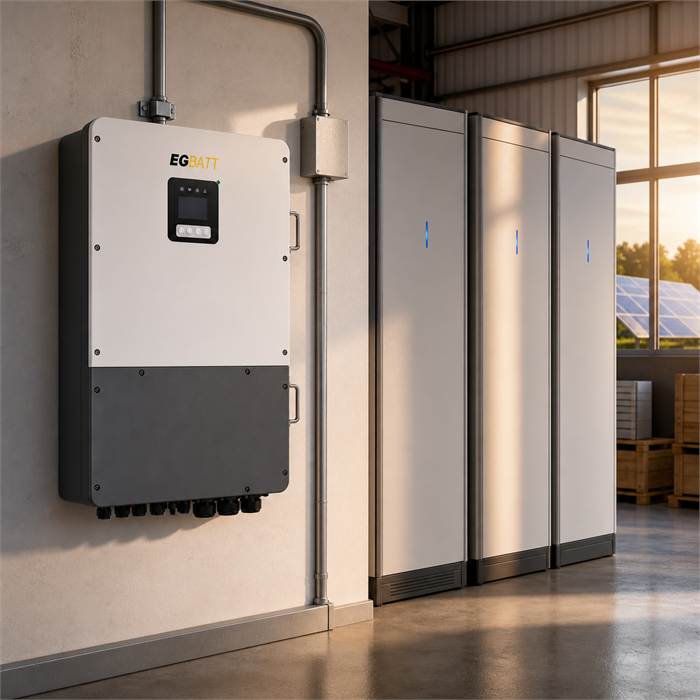
A high-voltage battery may fall inside the inverter’s published DC operating range and still be incompatible. Before purchasing a commercial solar battery inverter, confirm all of the following:
- Operating voltage: the battery’s minimum, nominal and maximum voltage must remain within the inverter’s permitted range.
- Power and current: the battery must deliver the required charge and discharge power without exceeding battery, cable or inverter current limits.
- BMS communication: CAN or RS485 protocol, firmware, addressing and cable pinout must match.
- Approved combination: obtain written confirmation for the exact inverter model, battery model and firmware versions.
- Protection and isolation: verify DC disconnects, overcurrent protection, grounding and emergency shutdown requirements.
- Environmental limits: battery and inverter temperature, humidity, altitude and enclosure ratings must suit the installation location.
Battery energy in kilowatt-hours determines approximate runtime, while inverter and battery power in kilowatts determine how much load can be supported at one time. Both values matter. A large battery with insufficient discharge power cannot support a high-demand load, and a high-power inverter with too little usable battery energy will provide only short backup duration.
Check the PV Array and MPPT Design
Commercial rooftops often have multiple orientations, shading zones or module groups. Multiple MPPT trackers can help separate these array conditions, but every string still needs to remain within the inverter’s electrical limits.
Verify maximum open-circuit voltage at the site’s lowest expected temperature, operating voltage across the normal temperature range, current per string, strings per MPPT and total permitted PV input. Also distinguish between recommended array sizing and the inverter’s maximum usable DC input. Oversizing rules must follow the manufacturer’s design guidance and applicable electrical requirements.
The CMX Battery platform discussed here provides four MPPT trackers and eight PV inputs. Its exact string configuration should be checked model by model before the array is finalized.
Decide What “Backup” Means for the Business
“Backup power” can mean very different things to a warehouse, a farm and a retail building. Create a priority list before sizing the system:
- Which circuits must remain operational?
- Can large noncritical loads be disconnected automatically?
- How long must the site operate without the grid?
- Can solar recharge the battery during an extended outage?
- Is a generator required for seasonal or multi-day resilience?
- What transfer time can the connected equipment tolerate?
An EPS transfer specification is only one part of backup design. The protected-load panel, switching arrangement, battery state of charge, load-starting behavior and control logic determine how the system performs in practice. Sensitive processes may require a separate power-quality or UPS assessment.
Peak Shaving, Time-of-Use Control and Export Limitation
For many businesses, the main financial value comes from how the inverter is controlled rather than from backup alone.
Peak shaving
The battery discharges when facility demand approaches a defined limit. Successful peak shaving requires a suitable tariff, accurate metering, enough battery power to reduce the peak and enough stored energy to sustain the discharge window.
Time-of-use load shifting
Solar energy or lower-cost grid energy can be stored for use during a higher-price period, where permitted. The economic result depends on the tariff spread, round-trip losses, battery cycling strategy and actual load timing.
Zero-export or export limitation
A compatible meter or current transformers measure power flow at the grid connection so the system can limit export. Meter location, polarity, communication and commissioning are critical; a configuration error can cause inaccurate control.
Before promising savings, model the project using real interval consumption, tariff rules, demand charges, seasonal PV production and the proposed operating strategy.
New Solar, Retrofit or Generator-Assisted System?
A new DC-coupled project can coordinate PV and batteries through the hybrid inverter from the beginning. A site with an existing grid-tied solar system may instead consider AC coupling, subject to model compatibility and control requirements. Remote or outage-prone sites may add a generator, but generator voltage, frequency, neutral-ground arrangement, minimum loading and start/stop control must be confirmed.
Ask the supplier for a system-level review rather than treating the inverter as an isolated component. The review should cover the single-line diagram, battery communication, PV strings, metering, generator logic, protection devices and commissioning responsibilities.
A Practical 30–70kW Commercial Hybrid Inverter Option
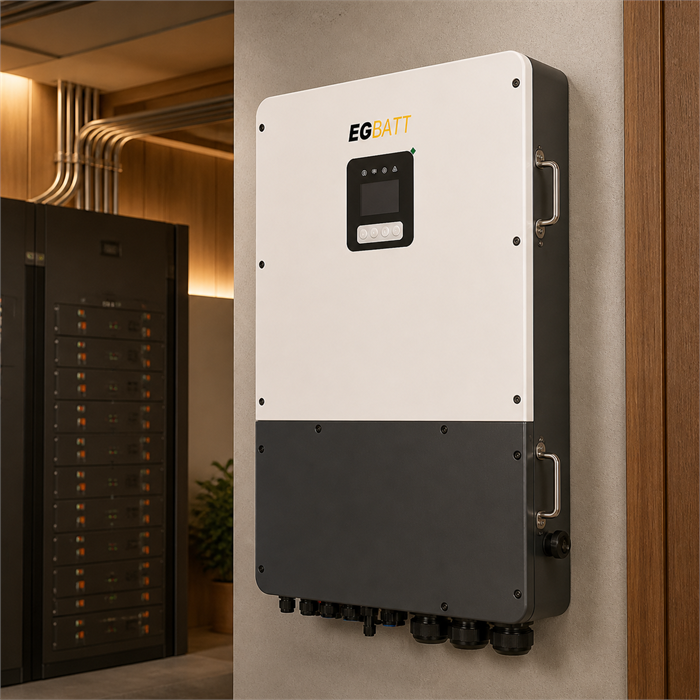
For projects that need native three-phase voltage options, the CMX Battery 30–70kW commercial hybrid inverter for 208V and 480V systems offers a 30kW 120/208V model and 40kW, 50kW, 60kW and 70kW 277/480V models.
The platform supports a 150–850V high-voltage battery range, CAN/RS485 battery communication, four MPPT trackers, eight PV inputs, AC coupling, optional generator integration, export control, EPS backup and parallel operation of matching units. Final compatibility and model-specific electrical limits must be confirmed for each project.
Commercial Hybrid Inverter Selection Checklist
Before requesting a quotation, collect these project details:
- Country, state or utility territory
- 120/208V or 277/480V service and grid configuration
- Single-line diagram or clear panel information
- 12 months of utility bills and interval load data, if available
- Continuous demand, peak demand and motor-starting loads
- Critical-load list and required backup time
- Existing and proposed PV capacity, modules and string design
- Battery model, voltage range, usable energy and power
- Required operating mode: self-use, TOU, peak shaving, backup or zero export
- Generator details, if included
- Indoor or outdoor location, temperature and altitude
- Project schedule and expected future expansion
This information allows the inverter, battery and PV design to be evaluated together and reduces the risk of voltage, communication or sizing problems later.
Frequently Asked Questions
What is the main difference between a 208V and 480V commercial hybrid inverter?
The primary difference is the three-phase AC service the inverter is designed to connect to. A 208V inverter is used with 120/208V service, while a 480V inverter is used with 277/480V service. The correct choice is determined by the building’s electrical system, not by a general preference for one voltage.
Is a 480V hybrid inverter more efficient than a 208V inverter?
Not automatically. At the same power, a higher AC voltage normally means lower current, which may reduce conductor size and distribution losses. Total system efficiency still depends on inverter efficiency, cable length, transformers, switchgear, battery operation and load profile. A native-voltage design usually avoids the losses and complexity of an unnecessary transformer.
When should a business choose a 30kW 208V inverter instead of a 60kW 480V inverter?
Choose according to both service voltage and required power. A 30kW 208V inverter fits a 120/208V site whose continuous, peak and backup loads remain within the model’s limits. A 60kW 480V hybrid inverter is intended for a 277/480V site with higher power demand. The two models are not interchangeable simply because one has a larger kilowatt rating.
Can a 480V hybrid inverter be used on a 208V commercial service?
Not directly. The inverter’s AC voltage and grid configuration must match the interconnection point. A transformer may be technically possible in some designs, but it adds cost, losses, protection requirements and engineering complexity. A native-voltage model is often the cleaner option.
Is inverter kW the same as battery kWh?
No. Inverter kW describes power—the amount of load the inverter can serve at a given time. Battery kWh describes energy—the approximate amount available over time. A commercial system needs both adequate power and adequate usable energy.
Can one commercial hybrid inverter back up an entire building?
Sometimes, but it depends on continuous load, peak demand, motor starting, battery power and the inverter’s off-grid capability. Separating critical loads is often more practical and economical than backing up every circuit.
Can a commercial hybrid inverter work with an existing solar system?
Some models support AC coupling for retrofit projects. Compatibility, control behavior, frequency response, metering and allowable AC-coupled power must be confirmed for the exact equipment combination.
How many commercial hybrid inverters can be connected in parallel?
The CMX Battery 30–70kW platform supports up to six matching units in parallel, subject to the required communication, protection and system-engineering conditions. Do not mix models or assume parallel capability without confirming the project design.
Discuss Your Commercial Solar and Battery Project
A reliable proposal starts with the site voltage, measured load, critical-load plan, PV array and battery requirements. Send us those details and we can help you identify the appropriate inverter model and the compatibility questions that should be resolved before installation.
Commercial electrical and energy-storage systems must be designed, installed and commissioned by qualified professionals in accordance with applicable codes, utility requirements and manufacturer instructions.